
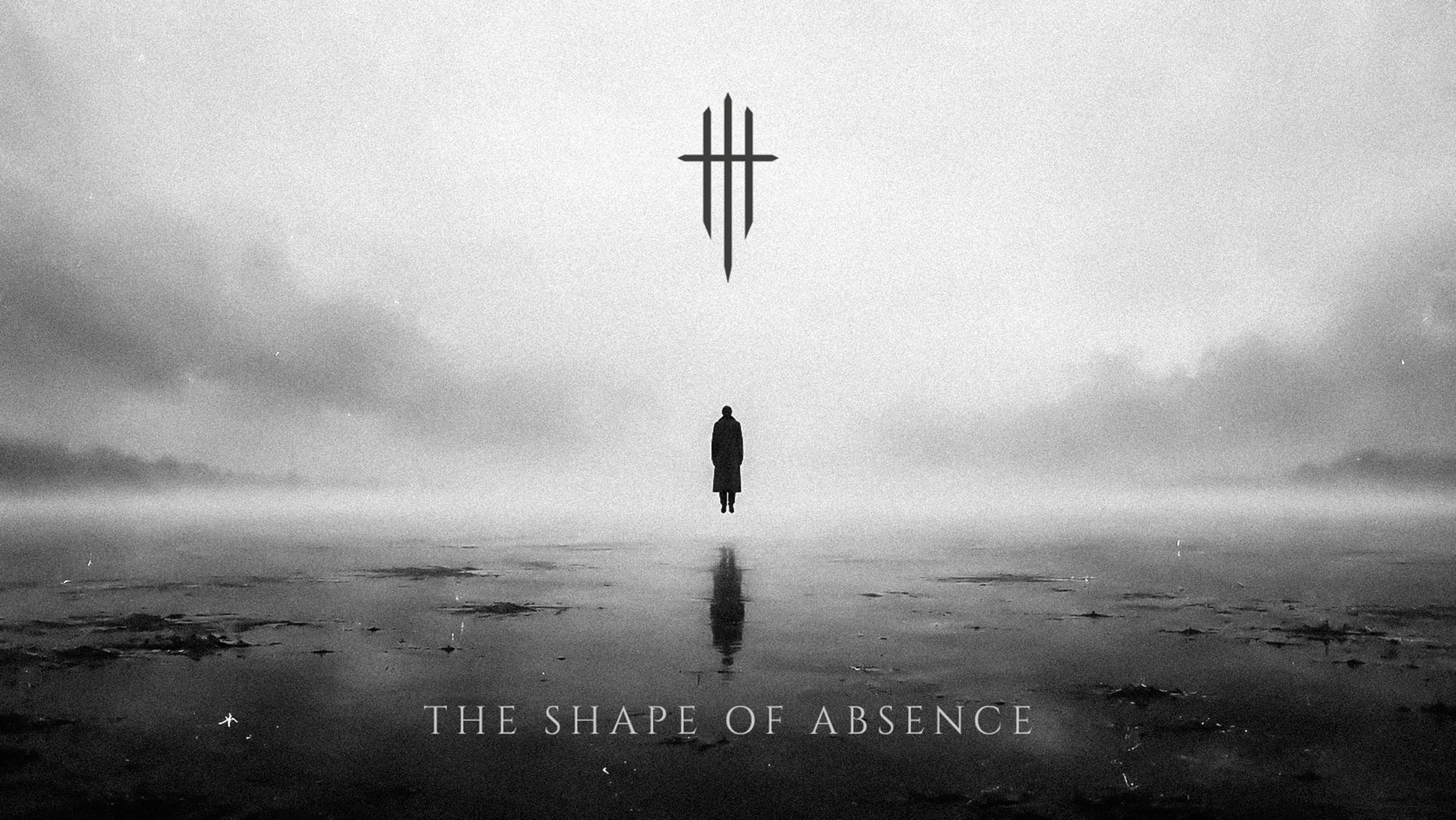
The story behind the album, by Vlad Sartor / THRN
I've been thinking a lot lately about how much of our lives we spend fighting things we have absolutely no control over. Situations we can't change, people we can't reach, things we've lost or never really had in the first place. And yet we keep trying, sometimes long after we've exhausted every reasonable possibility.
I suppose that's where The Shape of Absence really began. Not with a particular melody or an idea for a new musical direction, but with a realization that took me quite a while to arrive at.
Not every battle is mine to fight.
It sounds simple enough when you put it into words, but actually accepting it is something entirely different. We spend years learning to be persistent, to push harder, to refuse defeat. Nobody really teaches us how to recognize the point where persistence stops being a strength and becomes something that slowly consumes us.
That's what I wanted to explore with this album.
A Different Side of THRN
THRN has always been a way for me to express things that aren't particularly easy to talk about. Over the years, I've explored different musical directions, but there's always been a certain darkness running through them. Melancholy, isolation, the more uncomfortable parts of being human. Those things have never been particularly difficult for me to connect with creatively.
This time, though, I wanted to approach them differently.
I didn't want another album built around lyrics, verses and choruses. I wanted something that could exist without constantly demanding the listener's attention, something you could disappear into for a while without having someone else's story placed in front of your own.
That was probably the most important decision I made while developing The Shape of Absence: to leave the vocals out.
After spending so much of my musical life working with my voice, it felt strange at first. But the more I thought about it, the more sense it made.
I've always found it fascinating how two people can listen to exactly the same instrumental piece and experience completely different things. One might associate a melody with someone they miss. Another might hear something comforting in it, while somebody else finds it deeply unsettling. Neither interpretation is wrong.
Sometimes we hear things in music that aren't actually there. We imagine words, conversations, places, entire memories. And sometimes those imaginary details mean more to us than anything the composer could have deliberately put into the music.
I didn't want to interfere with that.
Giving the Absence a Shape
Musically, the album became a mixture of atmospheric post-rock, dark ambient, fragile piano melodies, slowly evolving synthesizers and the occasional industrial texture. Some of those elements have been part of THRN for a long time, although here they're used in a much more restrained way.
I wanted the compositions to breathe. To leave enough space between sounds for the listener's own thoughts to become part of the experience.
There are moments of considerable tension, but also passages where almost nothing seems to happen. Just a distant melody, a slowly changing harmony or a sound that gradually disappears into the background.
That contrast matters to me because anxiety doesn't necessarily announce itself. It can sit quietly somewhere in the background for years, affecting everything without ever becoming particularly visible to anyone else.
And loneliness is a strange thing, too. You don't have to be physically alone to experience it.
The nine compositions follow a loose emotional progression rather than a literal story. Air Without a Source begins with uncertainty and emptiness. The following pieces move through isolation, anxiety and the struggle to hold on to things that are already slipping away.
Everything We Could Not Keep is perhaps the closest the album comes to a final confrontation. After that, something begins to change. A Signal Through the Soil gradually withdraws from the struggle, and by the time After the Last Light arrives, there is no longer anything left to resist.
At least, that's how I hear it.
Someone else might experience the entire album differently, and I genuinely hope they do.
This Is Not My Battle
I think one of the hardest things to accept is that effort doesn't guarantee an outcome.
You can do everything right, give something all your time and energy, and still end up exactly where you started. Sometimes even worse off.
Of course, there are things worth fighting for. I'm not suggesting otherwise. But there are also situations where we continue struggling simply because we can't accept the possibility that we have no influence over the outcome.
And the longer we keep doing that, the more of ourselves we lose in the process.
Experience has a way of teaching us these things, although usually not in a particularly pleasant manner. We learn through mistakes, disappointments, losses and situations we never expected to find ourselves in.
Eventually, if we're paying attention, we begin to recognize certain patterns. We become a little better at distinguishing between something difficult but possible and something that is simply beyond our control.
I don't think that recognition makes the pain disappear. It doesn't magically fix anything, either. But it can change the way we carry it.
For me, that's the difference between giving up and letting go.
Giving up suggests you've been defeated. Letting go can be a conscious decision to stop allowing something you cannot change to dictate the rest of your life.
And sometimes the most important thing you can say to yourself is simply: This is not my battle.
Thirty-Eight Minutes to Yourself
I don't expect this album to change anyone's life. I don't think music works that way, at least not on command.
What I wanted to create was something much simpler.
A little over thirty-eight minutes of space. Somewhere you can retreat for a while, put on your headphones, close your eyes if you feel like it, and be alone with your thoughts without having to explain them to anyone.
There's no message hidden in the lyrics because there are no lyrics. I'm not going to tell you which memories to revisit, which emotions to confront or what conclusions you should reach.
Those things are yours.
Maybe the music will remind you of something you've been carrying around for years. Maybe you'll imagine somewhere you've never been. Maybe you'll just enjoy the atmosphere without attaching any deeper meaning to it.
That's perfectly fine, too.
The point was never to make everyone feel the same thing. Quite the opposite, actually.
I wanted to make something personal without making the listener's experience about me.
And perhaps that's what makes The Shape of Absence a little different from my previous work with THRN. Instead of trying to communicate everything through my own voice, I've deliberately stepped aside and left that space open.
The music is there. What you bring into it is entirely up to you.
I still believe there's value in fighting for what matters. I probably always will. But I've also come to believe that knowing when to stop is just as important as knowing when to keep going.
The Shape of Absence isn't about defeat, and it isn't really about finding some perfect state of inner peace, either. I don't think life is that straightforward.
It's about recognizing our limits, accepting that some things will remain unresolved, and understanding that we don't have to spend the rest of our lives fighting them.
Sometimes, victory isn't about fighting harder. It's about realizing you no longer have to.
— Vlad Sartor / THRN
This player is hosted by YouTube. Loading it sets third-party cookies.